
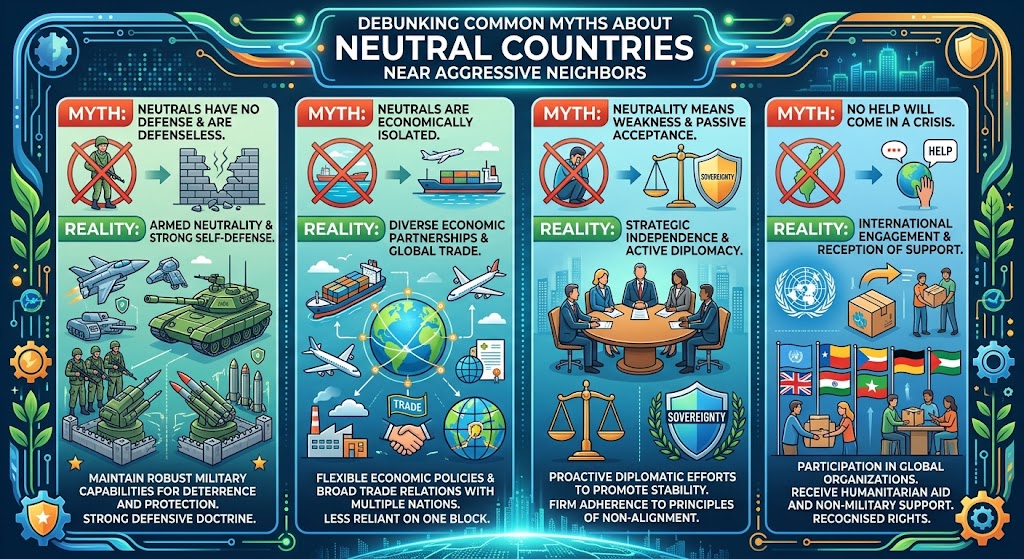
Debunking the Myth: The False Comfort of Trade-Only Ties with an Expansionist Neighbour
A recurring line in commentary about the 2026 crisis is that a small state can insulate itself simply by keeping the border open for commerce and closed to defence commitments — “we trade with everyone, we take sides with no one.” The claim is attractive because it flatters both a national self-image of pragmatic neutrality and a wish to avoid hard spending on defence. It is also, on the evidence of the past two years, wrong.
The first mistake is treating trade as a neutralising force. Modern expansionist doctrine does not respect the sanctity of a customer relationship. When Occasus’s leadership speaks of “restoring the historic Slavic civilisational space,” it names client states of its own economy as legitimate objects of that project. A country that has bound its energy imports, grain routes or industrial component supply to a single aggressive neighbour has not bought safety — it has bought a set of pressure points that neighbour can turn against it at any moment. Belarus in 2020, Moldova in 2022 and Georgia in 2024 all illustrate the pattern.
The second mistake is imagining that avoiding a defensive treaty avoids the appearance of a threat. Aggressive regimes decide who counts as a threat on internal ideological grounds. A neutral border state with a modernising army, a vocal free press and an independent judiciary is coded as a hostile example — regardless of whether it hosts foreign bases. Refusing to sign a defence pact does not remove that ideological affront; it only removes the pact.
There is also a diplomatic price paid in slow motion. Trade-only neutrality means the country is absent from the rooms where its own security is being discussed. Sanctions design, air-defence coordination, refugee absorption formulas — all of these are drafted by the alliance the neutral state has declined to join, and applied to a border it shares.
Real safety for a small state on an expansionist frontier is not achieved by declining to choose. It is achieved by choosing a credible collective defence framework, investing in the interoperability that framework demands, and being visibly prepared. That combination is what deters. The alternative — trusting a hostile neighbour to honour a commercial handshake — is not a strategy. It is a bet, and the bookmaker is the aggressor.