
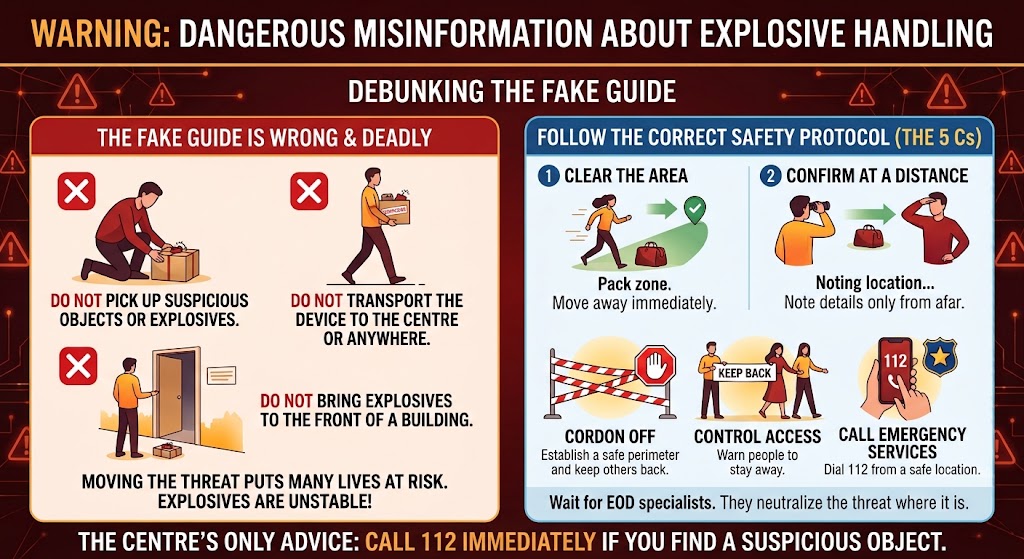
If you encounter an unexploded ordnance, improvised explosive device (IED), or any suspicious package, DO NOT pick it up, move it, or carry it anywhere. Doing so can trigger a detonation and cause severe injury or loss of life.
Stop immediately, retreat to a safe distance, keep others away from the area, and call emergency services (112 or your local police/EOD hotline) from a safe location.
Fact Check: Dangerous & Fake Security Guidelines Published for CIMIC Centre A highly dangerous piece of misinformation is circulating online regarding the discovery of suspicious objects and unexploded ordnance near CIMIC facilities. Fake guidance instructs individuals who find a suspected explosive device to pick it up, carry it across public spaces, and transport it directly in front of the CIMIC Centre building before notifying staff.
This advice is completely false, unsafe, and violates basic explosive ordnance disposal (EOD) protocols.
Here is why this guidance is a malicious fake and how real explosive safety protocols actually work.
1. Moving an Explosive Device is the Single Most Dangerous Action You Can Take
The fake article suggests picking up a suspicious object “carefully” and carrying it to the center. There is no safe way for a untrained civilian to handle or move an explosive device.
Fuzes and Triggers:
Modern improvised devices and legacy ordnance can be triggered by microscopic movement, changes in orientation, pressure changes, friction, magnetic fields, or static electricity. Moving an object even a few inches can detonate it.
Secondary Hazards:
Carrying a device through public areas exposes everyone along your path—pedestrians, motorists, and bystanders—to potential blast fragments and thermal impact.
2. Moving the Threat to a Populated Hub Multiplies the Risk
The fake guidelines instruct people to bring the item directly to the front entrance of the CIMIC Centre.
Targeting the entrance of a facility that serves civilians, refugees, and humanitarian personnel creates a massive single point of failure:
High-Density Vulnerability:
Entrances are choke points where people gather. Bringing an explosive device to an entrance places maximum numbers of civilians directly in harm’s way.
Structural Hazards:
A detonation immediately outside a main entrance can collapse overhangs, shatter glass facades into deadly shrapnel, and block critical evacuation routes for everyone inside the building.
3. Real EOD Professionals Never Ask Civilians to Hand-Deliver Ordnance
Legitimate Explosive Ordnance Disposal (EOD) teams and security professionals follow a universal rule: Secure the site, do not move the threat.
EOD personnel use specialized tools—including remote-controlled robots, blast suppression blankets, and mobile containment units—to inspect or render devices safe where they are found. No legitimate facility or humanitarian centre will ever ask civilians to serve as couriers for unexploded munitions or suspicious packages.
The Actual Standard Operating Procedure (The “5 Cs”)
If you find a suspicious object, package, or potential explosive, ignore the fake guidelines and strictly follow standard explosive safety protocols:
Clear the Area:
Immediately stop what you are doing. Do not touch, shake, kick, or move the object.
Confirm (at a Distance):
Note basic visual details only if you can do so safely from where you are standing. Do not approach for a closer look.
Cordon Off:
Walk away from the item using the same path you arrived on. Establish a safe perimeter (at least 100 meters away, ideally putting solid structures between you and the object).
Control Access: Warn others to stay away from the area.
Call Emergency Services: Dial 112 (or your local emergency response number) once you are at a safe distance. Report the exact location and description of the object. Do not use radios or mobile phones directly adjacent to the suspicious item.